

The secret of large fruits revealed: Universal instructions for masterful blueberry pruning
The Secret to Big Berries Revealed: The Ultimate Guide to Pruning Blueberries
Every grower dreams of bushes laden with large, juicy, and sweet blueberries. While the variety determines the potential, the key to unlocking it lies in one of the most important, yet most feared, steps – precise pruning.
“Many gardeners are afraid to pick up the shears, fearing they will harm the plant or lose their harvest. But the opposite is true. A neglected bush weakens, becomes overcrowded, produces smaller and smaller fruit, and is more susceptible to disease.”
This universal guide, based on the methodology of experts from North Carolina State University, will walk you through the entire process step-by-step. It will eliminate uncertainty and teach you to think like a professional, so you can transform your bushes' potential into a real, high-quality harvest every year.
The Foundations of Success: When and What to Prune With?
Before we get to work, let's clarify two key things.
Timing:
The ideal time is in late winter (February - March), during the plant's dormancy. The bush is leafless, its structure is perfectly visible, and you know exactly where to cut.
Tools:
- Hand Pruners (Secateurs): For thinner twigs and finishing touches.
- Loppers: Essential for removing old, thick canes near the ground.
- Disinfectant (Rubbing Alcohol): An absolute must! Always disinfect your tools before you start and when moving between plants. This prevents the spread of disease.
Make your cuts smooth and clean, without leaving stubs, which are an entry point for infections.
Mastering the Pruning of Mature Bushes in 4 Steps
Forget chaotically snipping branches from the top down. Professional pruning always starts from the ground up. Apply this systematic process to every mature bush (usually plants purchased in 1.5-liter pots or larger).
Step 1: Clean Up the Base of the Bush
Imagine a circle about 30-45 cm (12-18 inches) in diameter around the base of the bush. Everything growing outside this circle must go. Also, remove all weak, spindly shoots inside the circle. The goal is to create a strong, compact base.
(Marked in blue on the diagram)
Step 2: Get Rid of Low and Crossing Branches
Remove all branches that grow too low, almost horizontally. The fruit on them would touch the ground. Also, remove any canes that cross over each other or grow through the center of the bush. The result will be an airy bush with predominantly upright canes.
(Marked in red on the diagram)
Step 3: Open the Center to the Sun
If the center of the bush is too dense, select 1 to 3 of the oldest, thickest canes and remove them completely, right at ground level. You can identify old canes by their gray color and thick bark, often covered with lichens. This step thins out the bush and makes room for new, productive wood.
(Marked in black on the diagram)
Step 4: Remove "Twiggy Brooms" and Shorten Overgrown Canes
As canes age, they branch out at the ends into dense clusters of thin twigs that resemble a broom. This "twiggy" growth produces only a few tiny berries. Don't be afraid to remove these clusters entirely. Finally, shorten any canes that are disproportionately long or tall. This will encourage them to branch out and become stronger.
(Marked in purple and green on the diagram)
The Most Common Mistakes You Will Now Avoid
- Pruning too hard: Never remove more than 25-30% of the bush's volume at once. This will weaken the plant.
- No pruning at all: Leads to an old, overgrown bush with a harvest of small, sour berries.
- Leaving stubs: Always cut just above a healthy bud or back to the branch collar. Stubs are an open invitation for infection.
- Tipping all the canes: Blueberries fruit on the tips of the previous year's growth. By cutting the ends off all canes, you would be removing most of your harvest. Only shorten canes selectively.
How to Handle Young Plants? Patience Brings Big Fruit
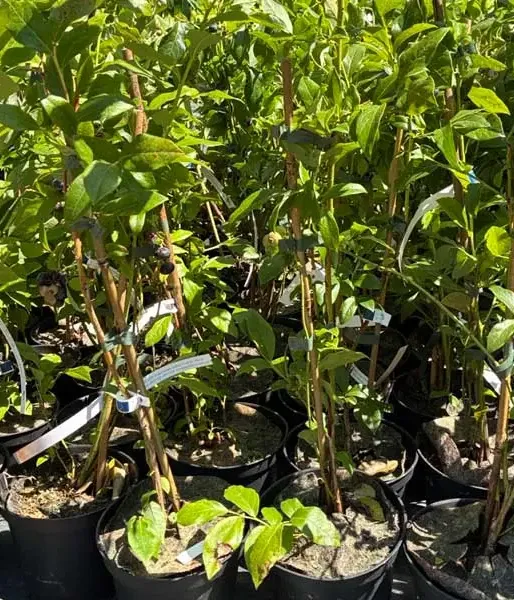
For young plants (typically from P9 pots), the goal for the first two years is not a harvest, but building a strong, healthy root system and bush structure.
- Pruning at Planting: Immediately after planting, cut the plant back by 1/2 to 2/3 of its height. Remove all flower buds. Yes, all of them.
- First Year: Do not allow the plant to produce fruit. It must invest all its energy into growing roots and canes.
- Second Year: Perform a basic pruning (remove weak and low-lying shoots). If the bush grew vigorously, you can leave a few flower buds for a small taste test. The priority, however, is still growth.
- Third Year: The bush is ready for its first serious harvest. Even so, remove about 30-50% of the flower buds through pruning to prevent it from being overloaded.
Conclusion and Key Takeaway: Don't Be Afraid to Prune!
A correctly performed pruning always means removing at least one-third of the flower buds. This is hard for many growers to do, but it is absolutely essential. Overloading a bush with fruit in one year causes immense stress, resulting in a weak or non-existent harvest the following year and tiny berries.
Remember: Less is sometimes more. By selectively reducing buds and canes, you concentrate the plant's energy into fewer fruits, which will be significantly larger, sweeter, and of higher quality.
Tips from a Pro
I always recommend that beginners buy older plants, where they can simply continue with maintenance pruning. If you are buying small plants in P9 pots, opt for PBR (licensed) varieties, which are more vigorous. After planting such a small plant, I leave only the single strongest cane and cut it back to 2-3 buds, building the bush up gradually. I prune mature plants exactly as described above, but I let the main stems grow taller and clear out the lower growth. My berries are often at a height of 1.2 - 1.5 m (4-5 ft). This has an interesting advantage – birds (especially thrushes) can't perch on the thin upper branches, and the harvest is better protected.
Start on your path to a dream harvest!
Choose from our selection of healthy and strong blueberry plants and apply these principles to achieve the harvest of your dreams.
Want to learn even more?
This article is just the beginning. If you want to dive deeper into the world of gardening, get exclusive tips, and access articles ahead of time, join our community!
Follow us on our Facebook page and always be one step ahead.
What are your experiences with pruning blueberries? Do you have any of your own tried-and-true tips? Share them in the comments!
Related Products