


Family Trees: How Can One Cherry Tree Bear Three Different Varieties?
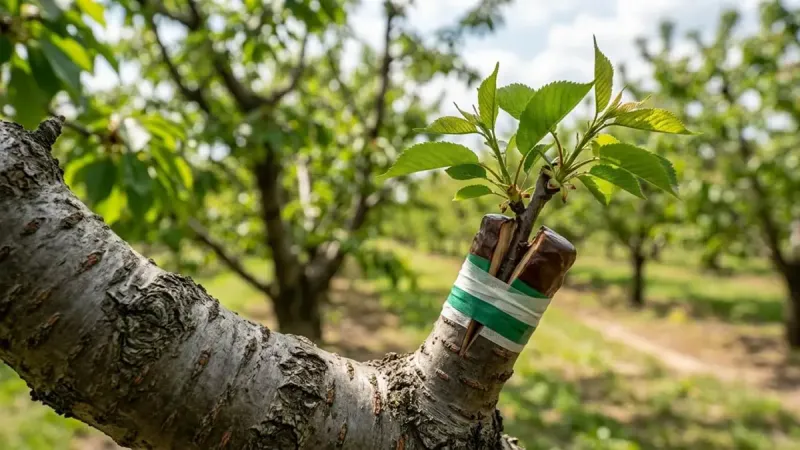
A Garden Miracle: How Can One Tree Bear Three Different Varieties?
Discover the science behind family trees and find out why multi-variety cherries are the perfect solution for modern gardens.
Imagine a tree where one branch bears early, light red, and crisp cherries, while another branch is loaded with late, dark, and exceptionally sweet fruits. Sounds like magic or genetic manipulation from a sci-fi movie? Not at all. This is a masterpiece of traditional horticulture known as a multi-variety (or family) tree.
This fascinating phenomenon is the result of centuries of perfected grafting techniques. Let's look under the bark of the tree and explain how it is biologically possible for a single trunk to nourish several completely different varieties without their traits mixing.
The Science Behind the Miracle: The Anatomy of Grafting
To understand a multi-variety tree, we must imagine it as a building kit composed of two main parts: the rootstock and the scions.
| Tree Part | Botanical Function | Importance for the Grower |
|---|---|---|
| Rootstock (Roots and trunk) | Draws water and nutrients from the soil. | Determines the tree's vigor, cold hardiness, and drought resistance. |
| Scions (Tree crown) | Perform photosynthesis and produce fruit. | Determine the variety, taste, color, and ripening time of the fruit. |
← Swipe the table sideways →
When creating a family tree, an orchardist takes one strong rootstock and grafts twigs from two, three, or more different varieties into its crown (or trunk). The key to success is a thin layer of cells under the bark called the cambium. When the cambium of the rootstock and the cambium of the scion connect and heal together, they form a shared vascular system. Water and nutrients from the roots can thus flow freely into all grafted branches.
Why Don't the Varieties Mix?
Although the branches share a common root system and the same sap flows through them, their DNA remains strictly separate. Each scion retains its own genetic information. Therefore, a branch from the 'Aleksandrs' variety will always bear only 'Aleksandrs' cherries and will never genetically mix with a neighboring branch of a different variety.
A Real-World Example: The Multi-Cherry Family Tree
A perfect demonstration of this horticultural art is the family multi-cherry tree, which combines three excellent varieties on a single trunk: 'Aleksandrs', 'Brjanskas 3-36', and '26-2'. Why did breeders choose this specific combination? The reasons are strictly pragmatic and solve the two biggest problems for cherry growers.
1. Perfect Cross-Pollination
Most cherry varieties are self-sterile. This means that if you plant only one tree in your garden, it will bloom beautifully in the spring, but without pollen from another cherry variety (blooming at the same time), it will produce almost no fruit. With a multi-cherry tree, this problem completely disappears. Because three different varieties bloom on one tree, the tree acts as its own pollinator. Bees simply fly from branch to branch, ensuring the maximum possible yield.
2. Gradual Ripening and Extended Harvest
If you have one standard tree, the entire crop ripens all at once within two weeks. Often, there is so much of it that you can't eat or process it in time. A family tree with three varieties is designed so that the varieties ripen gradually. The harvest is thus extended over several weeks, and you can enjoy fresh cherries much longer.
Extreme Space Saving in the Garden
Nowadays, when plots are shrinking and gardens are getting smaller, space is a luxury. If you wanted to grow three different cherry varieties the traditional way, you would need a huge area. The family tree solves this problem with incredible efficiency.
Space Required to Grow 3 Cherry Varieties
| 3 separate trees (Standard planting) | ~ 15 m² |
| 1 family tree (3 varieties on 1 trunk) | ~ 5 m² |
A multi-variety tree saves you up to 66% of space while maintaining species diversity.
← Swipe sideways →
The Golden Rule of Pruning a Family Tree
When growing a multi-variety tree, you must pay attention to balance. Different varieties may have different growth vigor. If you notice that one variety (branch) is growing much more vigorously and starting to crowd out the others, you must prune it back more during the spring pruning. The goal is to keep the crown symmetrical so that all three varieties receive an equal amount of sun and nutrients.
A family tree is not just a botanical curiosity. It is a highly practical solution that brings perfect pollination, a long harvest season, and a diverse palette of flavors on a single trunk to a small garden.
Plant 3 Cherry Varieties on 1 TreeSave space in your garden and solve the pollination problem. Order our unique family multi-cherry and enjoy a rich harvest of different flavors. Buy the Family Cherry Tree |
Join Fruit-Growing EnthusiastsExchange growing experiences, ask about proper pruning of family trees, and share your harvest in our Facebook community full of enthusiastic gardeners. Join us on Facebook |
Related Products