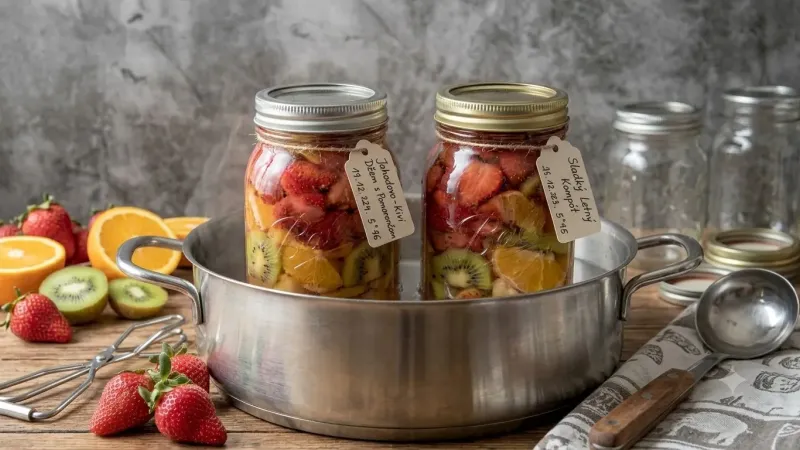
Summer is in full swing and the kitchen turns into a small production line. Crates of apricots, peaches, and plums sit on the counter, and the same old question comes to mind: should you peel the fruit, halve it, or drop it into the jar whole? For some, it is purely a matter of aesthetics or family tradition, but from a nutritional science point of view, it is a genuinely important decision. Every cut of the knife and every strip of peel removed sets off a cascade of chemical reactions that changes what you will actually scoop out of the jar months later. Let's look at how the anatomy of fruit and the way it is prepared affect the carotenoid content and other valuable compounds in your home-canned fruit.
The science behind it: Our main focus is fruit rich in carotenoids – beta-carotene, lutein, and lycopene – which protect our cells and eyesight. This applies above all to apricots, peaches, and mangoes, but also to tomatoes when canned whole. Heat during sterilization actually benefits these compounds, since it breaks down cell walls and makes them more bioavailable to the body (Ruiz-Rodriguez et al., 2008). However, the form in which the fruit goes into the jar determines how much of these compounds, and many others, actually remain.
Round one: peeled versus unpeeled fruit
Peeling fruit before canning – typical for peaches, apples, and pears – is, from a nutritional standpoint, one of the most drastic interventions you can make. So where is the treasure actually hidden?
Canned fruit with the skin on
- A protective shield and a concentration of nutrients: The skin is not just packaging. It is where the plant concentrates its strongest defensive compounds against sunlight and pests. Studies confirm that the skin (for instance in apples or peaches) contains a markedly higher amount of phenolic compounds, flavonoids, and antioxidants than the flesh alone (Nayak et al., 2015).
- A barrier against leaching: The skin acts as a physical barrier. During sterilization in hot syrup, it limits the excessive leaching of water-soluble vitamins (such as residual vitamin C) and minerals from the flesh into the liquid (Alshallash et al., 2023).
Canned fruit with the skin removed
- A significant loss of antioxidants and minerals: Removing the skin means losing the fruit's most valuable antioxidant layer. What's more, the exposed flesh is in direct contact with the hot syrup. Research shows that canning peeled fruit leads to substantial mineral losses – iron, calcium, and potassium – which simply leach out into the liquid (Alshallash et al., 2023). If you don't drink that syrup afterward, those nutrients are lost for good.
- Oxidation: Peeled fruit is immediately exposed to oxygen, triggering enzymatic browning and the oxidation of sensitive compounds even before the jar is sealed (Nayak et al., 2015).
Round two: cut and halved versus whole fruit
This question applies mainly to apricots, plums, and smaller peaches. Whether or not you halve the fruit has a direct effect on the stability of its carotenoids.
Canned whole fruit (with the pit)
- Maximum protection against oxidation: Whole, undamaged fruit – ideally with the skin still on – forms a perfectly closed system. The carotenoids inside are shielded from oxygen. Studies confirm that any cutting, crushing, or blending before heat treatment dramatically increases the oxidation and breakdown of carotenoids (Ruiz-Rodriguez et al., 2008).
- A bonus from the pit: Although we don't eat the pit, during long cooking and subsequent storage it can release trace amounts of specific compounds, such as amygdalin, into the flesh and syrup, lending the canned fruit its characteristic almond aroma.
Canned cut fruit (pit removed)
- An oxidative shock: Every cut of the knife damages cells and gives oxygen immediate access. Enzymes in the fruit react with oxygen right away, accelerating the breakdown of sensitive compounds. Research on carrots, for example, showed that grating and leaving them exposed to air before cooking caused greater carotenoid losses than the cooking itself (Ruiz-Rodriguez et al., 2008); with halved apricots the effect is milder, but still present.
- Increased leaching: Halving the fruit increases the surface area in direct contact with the hot syrup, so significantly more minerals and water-soluble vitamins leach into the liquid than would be the case with whole fruit (Alshallash et al., 2023).
How preparation method affects nutrient retention
The overview below summarizes the findings above – it is an approximate comparison based on trends reported in the cited studies, not exact measured percentages.
| Whole fruit with skin on |
Highest retention |
| Peeled fruit |
Reduced retention |
| Cut fruit without skin |
Lowest retention |
← Swipe sideways →
Retention of antioxidants and minerals in the canned fruit (Nayak et al., 2015; Alshallash et al., 2023).
The golden rule for all canned fruit: fat and syrup
Carotenoids need fat: Beta-carotene from apricots or peaches is fat-soluble (Sahu et al., 2024). If you eat a bowl of canned fruit on its own, your body will absorb only a fraction of its carotenoids. But if you serve it as a dessert after a meal that contained some fat, or add a spoonful of whipped cream, the availability of this "orange miracle" increases significantly.
Don't pour out the syrup: The liquid in a jar of canned fruit is not just sweet water. It is a solution into which a considerable amount of minerals (potassium, magnesium) and water-soluble antioxidants leached during sterilization (Alshallash et al., 2023). Pouring that syrup down the drain means pouring away part of the fruit's nutritional value.
From a nutritional science perspective, canned fruit left whole, unpeeled, and with the pit in represents the strongest combination of protection and nutrient bioavailability.
Conclusion
If we had to name a winner in the "healthiest canned fruit" category based on the scientific evidence, it would be fruit canned whole, unpeeled, and with the pit still in. This method of preparation creates a synergy: the heat of sterilization breaks down cell walls and makes carotenoids more bioavailable, while the intact skin and whole form of the fruit prevent their oxidation and limit the leaching of valuable minerals into the syrup.
Of course, in practice, convenience and presentation often win out – halved, pitted apricots are simply easier to eat. If you choose that route, process the fruit as quickly as possible after cutting to limit oxidation, and don't pour out that sweet, mineral-rich syrup. Your body will thank you for it.
Find varieties made for canning
Our selection includes proven apricot, peach, and plum varieties whose firm flesh and balanced sweetness make them ideal for canning. Discover trees that will keep rewarding you with a harvest for years to come.
Browse our varieties → |
Join our community of fruit growers
Swap growing tips, ask about varieties, and share your harvest in our Facebook community of enthusiastic fruit growers. Chat with experts and be the first to see new articles.
Visit our Facebook page → |