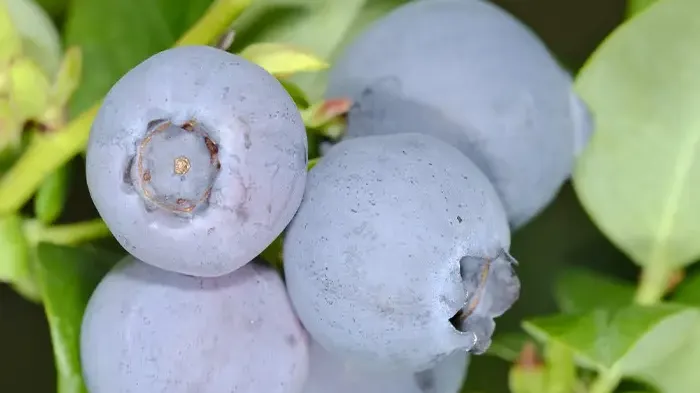
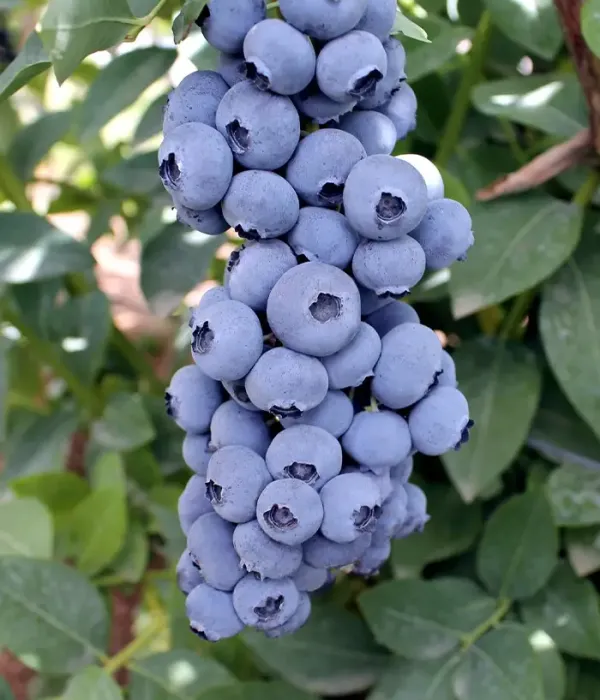
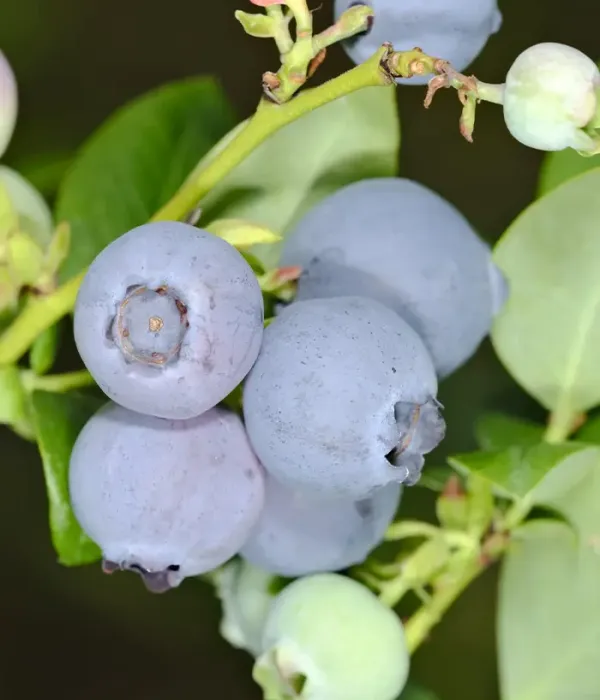
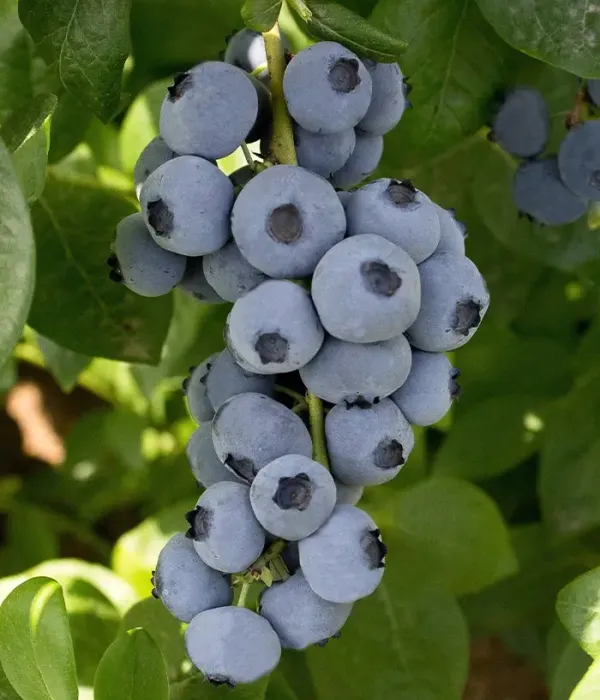
Five new varieties of highbush blueberry (Vaccinium corymbosum) have joined our shop. Four of them belong to the Northern Highbush group, the type most widely grown in Central Europe, and one to the Southern Highbush group. The varieties differ in ripening time, berry size and flavour, as well as in how much winter chill they need and how well they tolerate frost. Below you will find each variety in detail, a clear comparison and tips on which one to choose for your garden.
|
5
new varieties in our range
|
10–14
days earlier than ‘Duke’ – when ‘Clarksville’ ripens
|
20 mm
berry diameter of ‘MegasBlue’ at its largest
|
over 11
°Brix: sugar content of ‘Fayetteville’ berries
|
Two Groups of Blueberries, Two Different Needs
Northern Highbush is suited to mild and cooler climates and needs enough winter chill. Southern Highbush comes from warmer regions and needs less chill, but it tolerates hard frosts less well. Of the new varieties, only ‘Miss Alice Mae’ is a Southern type.
What are chill hours?
Blueberry plants rest over winter. To bud properly in spring and flower abundantly, they need a certain number of hours below 7 °C. This figure is called the chilling requirement and is given in chill hours. In most of Central Europe the needs of Northern Highbush varieties are usually met without trouble. Spring frosts during flowering deserve more attention.
The Five New Varieties in Detail
The varieties are listed roughly from the earliest to the latest.
‘Clarksville’
Ultra-early variety, Northern Highbush
‘Clarksville’ ripens 10 to 14 days earlier than ‘Duke’, one of the best-known early varieties. You can pick blueberries from it right at the start of the season, when demand for fresh fruit is highest. The berries are medium-sized, a lighter blue with a waxy bloom, reasonably firm and distinctly aromatic. Interestingly, their flavour keeps developing and improving during cold storage.
It needs only 400 to 500 chill hours, which is relatively little for a northern variety. It therefore suits milder winters or tunnel growing, while still keeping strong frost hardiness. It also has good natural resistance to common blueberry diseases.
Strengths: ultra-early harvest, aromatic flavour that improves in storage, low chill requirement combined with strong frost hardiness, reliable yields, good disease resistance.
Watch out for: the berries are medium-sized and do not reach the size of later varieties. Growth is semi-upright to spreading, so it needs shaping pruning to stop the branches bending to the ground under the weight of the crop.
‘Miss Alice Mae’
Early variety, Southern Highbush
‘Miss Alice Mae’ (syn. ‘TH-921’) is an early variety bred in Georgia, USA. It ripens at about the same time as the established early variety ‘Star’, but the fruit develops faster, in 60 to 68 days. The berries are medium to large (16 to 19 mm in diameter, 1.6 to 2.0 g) and purple-blue with a waxy bloom. The flavour is very good, the texture smooth and the sugar content (°Brix) higher than in ‘Star’ and ‘Camellia’. After picking, a small stem scar remains with minimal tearing, and the berries store well.
The bush is vigorous and semi-upright: at four years old it reaches 1.3 to 1.6 m, and 1 to 3 main shoots usually grow from a narrow base. Yield is very good: 4.5 to 6.8 kg per plant on plants four years and older under optimal conditions. It needs about 500 to 550 chill hours.
Strengths: early ripening, firm and sweet berries with good storage life, high yield and vigorous growth, low chill requirement.
Watch out for: frost hardiness is lower, as is typical for southern varieties, so it is not suited to cold northern or higher-altitude areas. It flowers early. It is only moderately self-fertile, so plant another variety next to it for a better crop.
‘Titanium’
Early to early-mid variety, Northern Highbush
‘Titanium’ (syn. ‘OBF0622’) is a modern variety bred in Oregon. There it reaches 50% ripeness in the first week of July. The berries are medium to large (about 18 mm), slightly flattened and round, purple-blue with a waxy bloom. Its main strength is extreme firmness: the berries resist bruising well, the stem scar left after picking is very small (about 1 mm) and dry, and storage life is excellent. The fruit contains very few seeds (often just 0 to 7) and the flavour is a harmonious sweet-tart, sweeter than ‘Draper’.
The bush is vigorous, upright and rather narrow: at 3 years old it is about 106 cm tall and 89 cm wide. Yield is medium-high to high. It needs about 1000 chill hours, so it is meant for mild and cooler climates.
Strengths: extremely firm berries and a dry scar, very few seeds, sweeter flavour, upright growth that takes up less space, medium-high to high yield.
Watch out for: the chill requirement is high, so it is not suited to very warm areas without frosty winters. The narrow, upright habit may call for pruning that lightly thins the bush and opens up its centre.
‘MegasBlue’
Mid-season variety, Northern Highbush
‘MegasBlue’ (syn. ‘OBF0604’) was bred in Oregon as an improvement on ‘Draper’: it has a more vigorous bush, a higher yield and larger berries. In Oregon it reaches 50% ripeness in mid-July. The berries are very large, up to 20 mm, shaped like a flattened sphere, with a powdery purple-blue colour and a pronounced waxy bloom. They are firm, and the stem scar is small (1.2 mm) and dry. They contain 0 to 20 tiny seeds, and the flavour is good, moderately sweet with low acidity.
Yield is exceptionally high and the berries ripen in a concentrated way, meaning most of the crop ripens within a short time. The bush is upright but very dense and broadly spreading: at 3 years old it is about 104 cm tall and up to 170 cm wide. Keep this in mind when planning the distance between plants. It needs about 1000 chill hours.
Strengths: very large, attractive berries, exceptionally high yield, concentrated ripening (the crop is picked in a shorter time), firm berries with a small dry scar, vigorous growth.
Watch out for: the wide, dense bush needs more space and careful thinning pruning so that air and light reach the centre. The chill requirement is high. If you want a longer picking period, combine it with varieties that ripen at other times.
‘Fayetteville’
Mid-late variety, Northern Highbush
‘Fayetteville’ comes from the University of Arkansas breeding programme and was developed with an emphasis on outstanding flavour. It ripens mid-late, so it extends the season at a time when early varieties are finished. The berries are medium-sized (15 to 17 mm, 1.6 g on average), blue with a good waxy bloom and reasonably firm, so they keep well after picking. Flavour is its trump card: the berries are exceptionally aromatic and distinctly sweet, with a sugar content above 11 °Brix.
The variety has strong frost hardiness and performs steadily even in cooler and higher-altitude areas. It needs only 400 to 500 chill hours. Growth is semi-upright to spreading. The plants set fruit well and give reliable yields.
Strengths: exceptionally sweet and aromatic flavour, mid-late harvest, strong frost hardiness, good berry firmness, reliable yield, low chill requirement.
Watch out for: the berries are medium-sized and do not reach giant dimensions, though their flavour more than makes up for it. The spreading habit calls for shaping and thinning pruning so the branches do not bend to the ground under the weight of the crop.
Variety Comparison
| Variety |
Group |
Ripening |
Berry |
Chill requirement |
Key strength |
| ‘Clarksville’ |
Northern Highbush |
ultra-early (10–14 days before ‘Duke’) |
medium-sized |
400–500 h |
flavour improves in storage |
| ‘Miss Alice Mae’ |
Southern Highbush |
early |
16–19 mm, 1.6–2.0 g |
500–550 h |
firmness and higher sugar content |
| ‘Titanium’ |
Northern Highbush |
early to early-mid |
about 18 mm |
approx. 1000 h |
extreme firmness, few seeds |
| ‘MegasBlue’ |
Northern Highbush |
mid-season |
up to 20 mm |
approx. 1000 h |
berry size and high yield |
| ‘Fayetteville’ |
Northern Highbush |
mid-late |
15–17 mm, 1.6 g |
400–500 h |
flavour (over 11 °Brix) and frost hardiness |
← Swipe the table sideways →
How Much Winter Chill Each Variety Needs
The bar shows roughly how many hours below 7 °C a variety needs. The longer the bar, the more winter chill it requires.
| ‘Miss Alice Mae’ |
500–550 h |
| ‘Titanium’ |
approx. 1000 h |
| ‘MegasBlue’ |
approx. 1000 h |
Scale: 0 to 1,200 hours below 7 °C. For varieties given as a range, the bar is filled up to the upper value. Dark green: northern varieties with a lower chill requirement. Medium green: northern varieties with a high chill requirement. Orange: southern variety with lower frost hardiness.
← Swipe sideways →
With blueberries, berry size is not the only thing that matters. Ripening time, frost tolerance and the flavour you expect from the first picking to the last count just as much.
Which Variety Suits Your Conditions
|
Cooler and higher-altitude areas: ‘Fayetteville’ and ‘Clarksville’ have strong frost hardiness. |
|
Milder winters or a tunnel: ‘Clarksville’ and ‘Miss Alice Mae’ need less chill. |
|
Less space: ‘Titanium’ has an upright, narrower bush (about 89 cm wide at 3 years). |
|
Allow plenty of room: ‘MegasBlue’ grows up to 170 cm wide and needs thinning pruning. |
|
A longer season: combine ‘Clarksville’, ‘Titanium’ or ‘MegasBlue’ and ‘Fayetteville’, which ripen at different times. |
|
Cold northern sites: ‘Miss Alice Mae’ has lower frost hardiness and is not suited to them. |
|
Warm areas without frosty winters: ‘Titanium’ and ‘MegasBlue’ need about 1000 chill hours. |
← Swipe the table sideways →
Soil and watering for all varieties
All highbush blueberries need acidic (pH 4.5–5.5), light, peaty and well-drained soil with regular watering. This applies to all five new varieties.
Varieties protected by breeders’ rights
All five varieties are protected by Plant Breeders’ Rights (PBR). Commercial propagation of these varieties without a licence is prohibited.
|
New blueberry varieties now in our shop
‘Clarksville’, ‘Miss Alice Mae’, ‘Titanium’, ‘MegasBlue’ and ‘Fayetteville’ are available in our shop. Choose by harvest time and the conditions in your garden, and extend your season of fresh blueberries.
View the varieties in the shop
|
Follow our Facebook page
Swap growing experience, ask about varieties and share your harvest on our Facebook page, home to a community of enthusiastic fruit growers. Join the discussion with experts and be the first to read new articles.
Visit our Facebook page
|