









All About the Sweet Cherry (Prunus avium): Origin & Botany
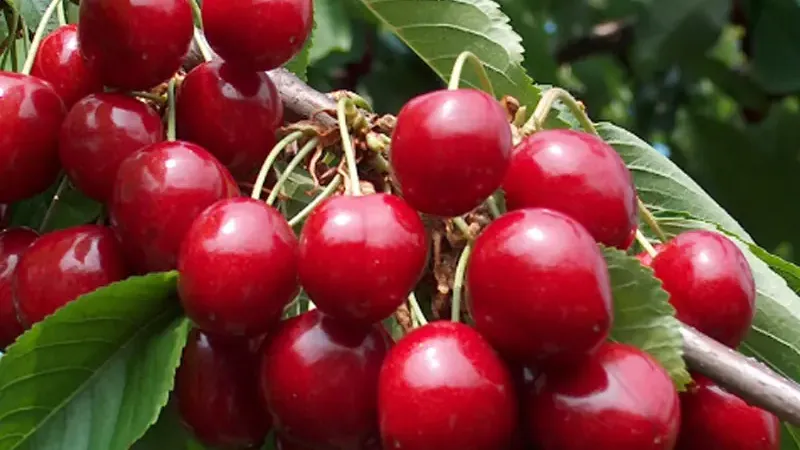
The Ruby Jewel of Our Orchards: The Botanical and Historical Story of the Sweet Cherry (Prunus avium)
When we think of the beginning of summer, many of us immediately picture trees laden with glossy, dark red fruits. The sweet cherry is not just a symbol of the warm months and a culinary delicacy, but from a scientific perspective, it represents a highly complex organism. Its journey from a wild-growing forest tree to a globally traded commodity that today graces orchards all over the world is a story of evolution, adaptation, and human perseverance.
Before this fruit reaches our table, the tree must undergo a complex physiological and botanical cycle. Let's dive together beneath the bark, into the structure of the leaves and flowers of this exceptional species, and get to know the wild cherry / sweet cherry (Prunus avium L.) as botanists and breeders see it.
“Genetically, the sweet cherry is a diploid species with two sets of chromosomes (2n = 2x = 16). This fact fundamentally distinguishes it from its close relative – the sour cherry, which is tetraploid and is believed to have originated from a natural hybridization between the sweet cherry and the dwarf cherry.”
1. Taxonomy and Genetic Origin: Where Are the Cherry's Roots?
From a botanical point of view, the sweet cherry, scientifically called the wild cherry (Prunus avium L.), belongs to the extensive rose family (Rosaceae), the subfamily Prunoideae (or Amygdaloideae), the genus Prunus, and the subgenus Cerasus.
The Journey from the Caucasus to Europe
The origin of the cherry dates back thousands of years. Fossil finds and archaeological excavations suggest that its homeland is the areas around the Black and Caspian Seas and the Caucasus Mountains. From there, thanks to the migration of humans and animals, it gradually spread to the temperate zones of Europe and Western Asia.
The Roman Distributors
The credit for domesticating cherries is attributed to the ancient Greeks. However, they were brought to the rest of Europe (e.g., England and Italy) from the region of northeastern Turkey by the Romans in the first century AD.
2. Tree Morphology: Fast Growth and a Short Life
The wild cherry is a medium-sized, fast-growing, but relatively short-lived deciduous tree. In the wild, it usually lives for 100 to 150 years, with fruiting beginning at the age of 10 to 15 years (in cultivated orchards, of course, much earlier).
- Dimensions: Grows to a height of 15 to 32 meters. The trunk diameter can reach 90 to 120 cm. The trunk is usually very straight.
- Bark: Characterized by a distinctive grayish-reddish-brown color. It is glossy, dotted with large horizontal lenticels, and in old age tends to peel horizontally in thin strips.
- Habit: Young trees have strong apical dominance (an upright, pyramidal shape). However, with increasing age, the crown becomes wider and more rounded.
Interesting fact: When the trunk or branches are injured, the tree produces an amber-colored, odorless gum (gummosis) that serves as a natural defense mechanism against infections.
3. Leaves and Flowers: Spring Awakening
Cherry leaves are alternate, simple, with an elliptic-ovate shape and a sharp tip (length 5–15 cm). On the upper side, they are matte and glabrous. In autumn, they offer a beautiful spectacle as they change color from green to yellow, orange-red, and scarlet.
Nectaries: A Sweet Surprise on the Leaves
A very prominent botanical feature of the cherry is the conspicuous pairs of dark red glands (so-called extrafloral nectaries). They are located on the petiole just below the leaf blade and serve to attract beneficial insects.
Flowering and Pollination
The flowers appear early in the spring, often before the leaves are fully unfurled. They are white, bisexual, and grow in raceme-like clusters of 2 to 5 flowers on short shoots (brachyblasts). In terms of reproduction, the cherry is an allogamous (cross-pollinated) species. Pollination is provided by insects, primarily honeybees. It is precisely this self-incompatibility that led to modern breeding programs aimed at developing self-fertile varieties for home gardeners.
4. The Fruit: A Drupe Full of Bioactive Compounds
Botanically, the cherry fruit is classified as a fleshy drupe. It consists of a central hard seed (endocarp) surrounded by fleshy pulp (mesocarp) and a thin skin (exocarp).
While wild forms produce small fruits with a diameter of 1 to 2 cm, modern breeding has brought varieties with fruits exceeding 30 mm in diameter and weighing 12 to 15 grams.
Attention During Harvest!
From a physiological point of view, the cherry is a non-climacteric fruit. After harvesting, it cannot continue to ripen, its sugar content does not increase, and it has a very low ethylene production. Therefore, it must be harvested only at the stage of full consumption ripeness.
What is the Difference Between a Sweet and a Sour Cherry?
| Feature | Sweet Cherry | Sour Cherry |
|---|---|---|
| Genetics | Diploid (16 chromosomes) | Tetraploid (32 chromosomes) |
| Taste | Sweet (13 - 25% dry matter) | Sour (more organic acids) |
| Cell Anatomy | Uneven distribution of subepidermal cells | Even distribution of cells |
5. Ecology and Environmental Requirements
In its natural habitat, the wild cherry is a light-demanding species. In forest ecosystems, it acts as a pioneer species – rapidly colonizing forest edges, clearings, and logged areas. Its seeds are spread mainly by birds and mammals.
Risks: Its shallow root system makes it vulnerable to uprooting in strong winds and sensitive to prolonged drought. It does not tolerate heavy clay soils and waterlogging. In terms of health, the tree struggles mainly with bacterial canker (Pseudomonas syringae), monilinia, and the cherry fruit fly.
Conclusion
The sweet cherry (Prunus avium) is a perfect example of how wild nature can combine with human intellect. From an inconspicuous forest tree, we have obtained a fruit species of global importance. Its botanical structure – from shallow roots to bark with lenticels, down to nectaries on the leaves – makes it a fascinating subject for science.
Next time you put a dark red cherry in your mouth, remember that you are tasting the result of millennia of evolution and the careful work of generations of growers.
Grow your own sweet rubies
View our offer of modern cherry varieties ➤
Interested in deeper knowledge from pomology?
Join our community and discuss with experts.
Join the VIP Facebook group HERE ➤