

The End of Astringency: Introducing 5 Varieties of Sweet Rowan and Its Hybrids That Will Change Your View of This Fruit
The End of Astringency: Introducing 5 Varieties of Sweet Rowan and Its Hybrids That Will Change Your View of This Fruit
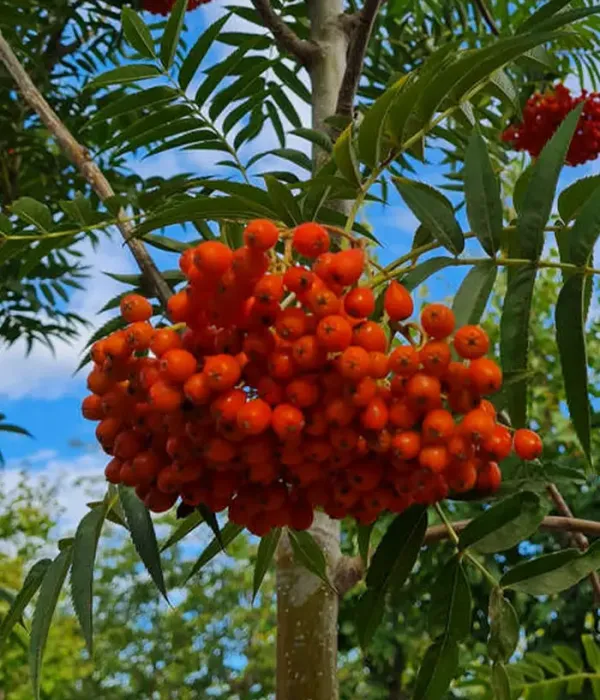
For most people, the rowan (mountain ash - Sorbus aucuparia) is just an ornamental tree along the roads. Its fruits, although beautiful, are practically inedible in their wild form due to strong astringency and bitterness. This was true until Russian breeders, led by the legendary I. V. Michurin, set to work, and European botanists discovered Asian island unique species.
For the 2026 season, we have included five exceptional varieties of rowan and its interspecific hybrids (rowan-chokeberries) in our offer. These trees yield an extremely frost-hardy crop (down to -40 °C) that not only has lost its astringency but, in the case of some varieties, surprises with unprecedented sweetness.
“The rowans from our offer do not require disease sprays or complex pruning. These are trees made for organic farming, permaculture gardens, and areas where other fruit species will not survive a freezing winter.”
1. 'Sacharnaja Petrova' (Petrov's Sugar Rowan): The Raisin Competitor
This historical, almost lost Russian variety is experiencing a renaissance. It was created by selecting the well-known 'Nevezhinskaja' rowan with a single goal: to achieve absolute sweetness.
Rowan Made of Pure Sugar
The fruits of this variety contain not a single drop of astringency or bitterness. While a common sweet rowan has about 8% sugars and 3.6% acids, 'Sacharnaja Petrova' reaches up to 13% sugars with only 1.3% acids. They can be eaten straight from the tree, and if left on the branches longer, they shrivel and resemble sweet raisins.
The tree grows moderately vigorously and is characterized by excellent tolerance to urban pollution (smog) and extreme frosts (-40 °C).
2. 'Doch Kubovoj' (Daughter of Kubovaja): Huge Harvest Without Astringency
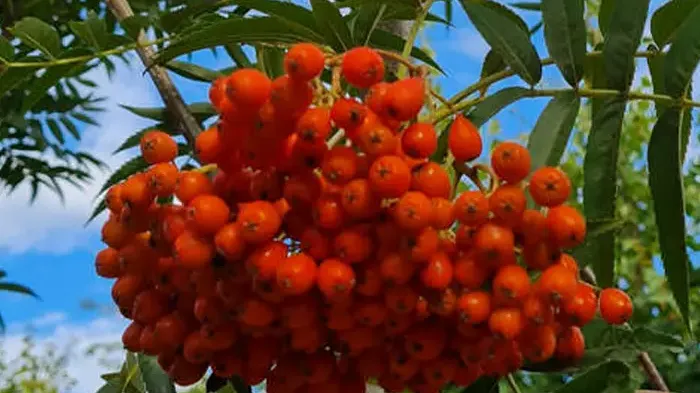
A modern Russian variety (registered in 1999) that pushes the boundaries of productivity. The mature tree grows into a broom-like shape and produces large, bright orange fruits (1.8 g) with bright yellow flesh.
Why choose it?
Besides the fact that its taste (rated 4.5 out of 5) is completely free of astringency, its main weapon is extreme productivity. In tests, it achieved an average yield of an incredible 36.2 tons per hectare, significantly exceeding common standards. It contains up to 30% dry matter, making it an ideal raw material for drying and processing.
3. 'Alaja Krupnaja' (Scarlet Large): Fruit with a Pear Pedigree
This medium-vigorously growing tree is the result of breeding that followed up on the work of I. V. Michurin. It was created by crossing the sweet-fruited Moravian rowan (Sorbus aucuparia var. moravica) and a hybrid (rowan x pear pollen mixture).
Gigantic Clusters
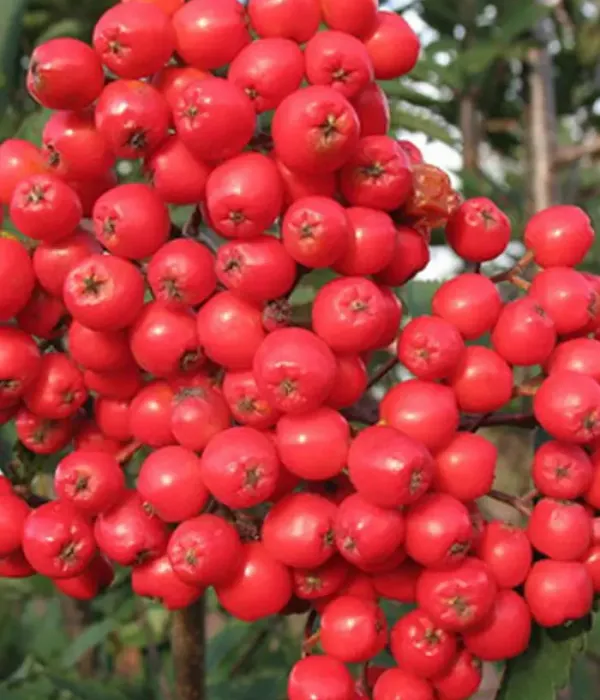
The fruits are scarlet-red, exceptionally large, and grow in huge, heavy clusters weighing 200 to 300 grams, which drastically simplifies harvesting. The taste is sweet and sour, with a spicy rowan flavor (desirable when making jams for venison and cheese), but without unpleasant astringency.
4. 'Burka': The Compact Rowan-Chokeberry
The 'Burka' variety (Michurin, 1918) is a botanical unique. It is an interspecific hybrid of rowan and black chokeberry (Aronia).
- Growth for small gardens: Forms a low, compact bush or a small tree up to only 1.5 – 3 meters high.
- Fruits: Have a dark burgundy color and produce red juice. The taste is sweet-sour with slightly tart notes inherited from the aronia (no bitterness).
- Traits: You can harvest up to 40-50 kg of fruit from a mature miniature bush. It is a self-fertile "iron" plant for eco-agriculture.
5. 'Dodong': An Exotic Gem from a Korean Island
Finally, something different. While the previous varieties were bred in Russia, 'Dodong' was discovered by a Swedish dendrologist on the isolated South Korean island of Ulleung (classified into the new species Sorbus ulleungensis).
The Queen of Ornamental Trees
This variety is primarily grown as a highly decorative solitary tree. It has huge leaves (up to 31 cm long) resembling palms, massive white inflorescences (up to 23 cm), and offers unsurpassed fiery (red-orange) coloring in autumn. It forms large yellow-orange fruits that are edible mainly after freezing. It blooms late, so it avoids spring frosts.
Quick Comparison: Which One to Choose?
| Variety | Tree/Bush Type | Fruit Color | Main Benefit for the Grower |
|---|---|---|---|
| Sacharnaja Petrova | Medium-strong tree | Orange-yellow | Sweetest taste, no astringency (like raisins) |
| Doch Kubovoj | Medium-strong tree | Bright orange | Extreme yield (36 t/ha), no astringency |
| Alaja Krupnaja | Medium tree/bush | Scarlet red | Huge & heavy clusters (up to 300g), spicy flavor |
| Burka | Low bush (up to 3m) | Dark burgundy | Rowan-chokeberry, ideal for small gardens & juice |
| Dodong | Strong tree | Yellow-orange | Exotic look, fiery autumn foliage colors |
Conclusion
Rowans are no longer just for the forest. Russian breeding work has turned this resilient fruit into a great choice for eco-orchards and home gardens where you don't want to worry about sprays. Whether you are looking for sweet "raisins" right from the tree ('Sacharnaja Petrova'), record harvests ('Doch Kubovoj'), dark fruits full of dye from a small bush ('Burka'), or a solitary tree that the whole street will envy ('Dodong'), you will find exactly what you are looking for in our 2026 offer.
Plant resilient fruit this spring
View our offer of sweet rowans ➤
Interested in growing lesser-known fruit species?
Join our community and consult with experienced growers.
Join the VIP Facebook group HERE ➤
Related Products