

Kiwi 'Luna Rossa®' and 'Minki Gold®' | Cultivars and Male Pollinators
Red- and Yellow-Fleshed Kiwi: 'Luna Rossa®', 'Minki Gold®' and Their Male Pollinators
Golden kiwi (Actinidia chinensis) offers smooth skin, tropical sweetness and earlier ripening – but without a male vine it will never set fruit
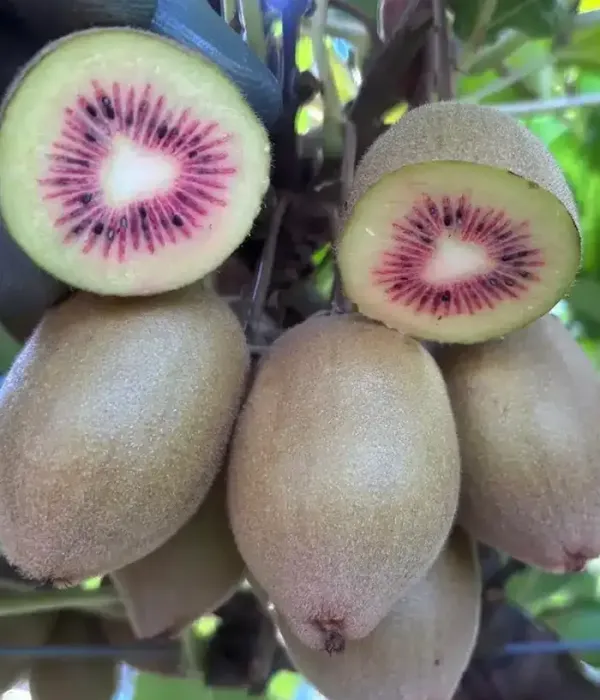
Yellow- and red-fleshed kiwifruit is one of the most interesting developments in modern fruit growing. These cultivars belong to Actinidia chinensis, a species distinguished from the familiar green kiwi (Actinidia deliciosa) by smoother skin, markedly sweeter fruit and earlier ripening. The trade-off is lower winter hardiness and greater sensitivity to late spring frosts. This overview covers two female cultivars – 'Luna Rossa®' and 'Minki Gold®' – together with two male pollinators, 'M33' and 'Minkimale®', without which no crop will ever form.
|
4
cultivars covered
|
1 : 3–5
male to female in a garden
|
−12 to −15 °C
hardiness of A. chinensis
|
Sep – Nov
harvest range of the group
|
Why Actinidia chinensis is different
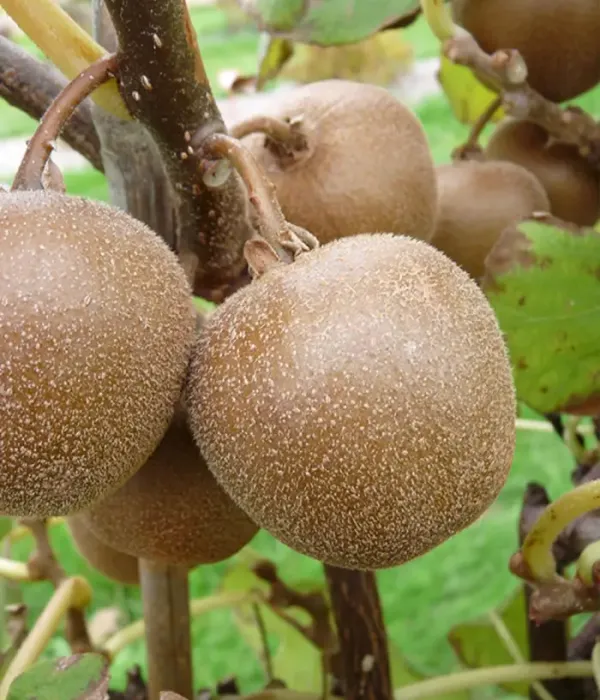
The distinction between the two main kiwi species is not merely botanical – it determines where you plant the vine and what you can expect from it. Cultivars of A. chinensis have an almost smooth skin, often with a bronze tint, lower acidity, sweeter and fruitier flavour, and they ripen earlier. In return they are more vulnerable to winter cold and break dormancy sooner, which exposes them to late frosts. The classic green kiwi A. deliciosa (for example 'Hayward') has a hairy skin, pronounced acidity, ripens late and tolerates winter better.
Important: pollen is not interchangeable between species
A female cultivar of A. chinensis needs a male vine of the same species flowering at the same time. Males bred for green kiwi flower later, and conversely, 'M33' flowers far too early for late-blooming green cultivars such as 'Hayward'. The wrong partner means unpollinated flowers and an empty trellis.
The female (fruiting) cultivars
The male pollinators
A male vine will not produce a single fruit. Even so, in a kiwi planting it is the most important purchase after the cultivar itself – it supplies the pollen without which the female flowers simply drop.
Winter hardiness and spring frosts
This is the decisive issue when growing yellow and red cultivars in Central European conditions. A. chinensis generally withstands winter temperatures down to about −12 °C to −15 °C, appreciably less than green kiwi. It therefore needs a sheltered, warm and sunny position – ideally against a south-facing wall – and thorough winter protection of the trunk in the first years after planting. The scales below compare indicative ranges for the individual species and illustrate the sensitivity of 'Luna Rossa®' to late frosts.
Winter hardiness of mature, well-ripened vines
| A. arguta (hardy kiwi) | approx. −25 to −30 °C |
| A. deliciosa (green kiwi) | approx. −18 to −20 °C |
| A. chinensis – 'Luna Rossa®', 'Minki Gold®', 'M33' | −12 to −15 °C |
Bar width is expressed against a range of 0 to −30 °C. These are indicative figures for mature, well-ripened vines in a sheltered position; young plantings are always more vulnerable.
← Swipe sideways →
| Sensitivity to late spring frosts – 'Luna Rossa®' | high |
| low sensitivity (favourable) | high sensitivity (risky) |
A qualitative illustration based on the cultivar description (early bud break and high sensitivity to late frosts). It is not a measured numerical value.
The four cultivars at a glance
| Cultivar | Function | Fruit and flesh | Ripening | Partner |
|---|---|---|---|---|
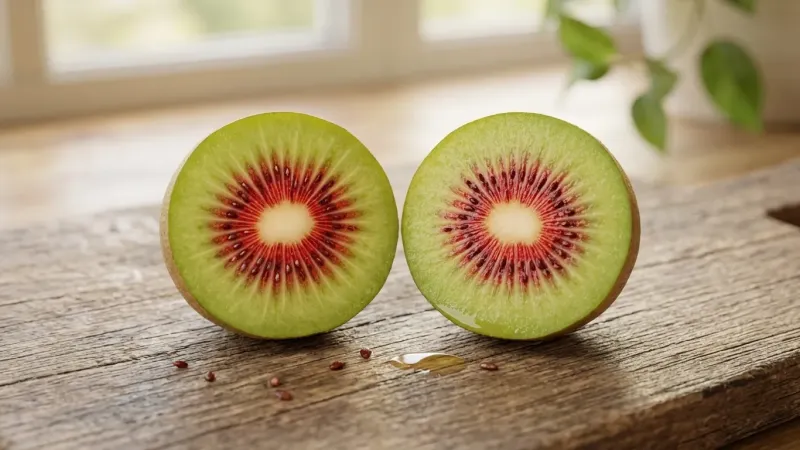
| 'Luna Rossa®' | female, fruiting | medium, oval; smooth skin, golden-yellow flesh with a red centre | September – October | 'M33' or another simultaneously flowering male A. chinensis |
| 'Minki Gold®' | female, fruiting | smaller, cylindrical; light bronze, finely felted skin, yellow flesh | around November | 'Minkimale®' |
| 'M33' | male pollinator | no fruit; extremely profuse flowering, high pollen output | flowers early, with early females | early yellow and bicolour cultivars, e.g. 'Luna Rossa®', 'Soreli' |
| 'Minkimale®' | male pollinator | no fruit; large, widely open flowers, leathery foliage | synchronised with 'Minki Gold®' | 'Minki Gold®' and other female A. chinensis |
← Swipe the table sideways →
With kiwifruit you are not buying a cultivar, you are buying a pair. A female vine without a male of the same species flowering alongside it can grow strongly and bloom for years – and never set a single fruit.
Securing a crop: three scenarios
| No crop – the garden holds only a female vine ('Luna Rossa®' or 'Minki Gold®'). Flowers appear, but without pollen they drop. | |
| Unreliable crop – a male is present but belongs to a different species or flowers at a different time (a 'Hayward' pollinator next to an early yellow cultivar, for instance). Pollination becomes a matter of chance. | |
| Reliable crop – a female cultivar plus a male A. chinensis with matching flowering time, planted no more than 3 to 5 metres away, ideally on the windward side and positioned so that the canopies partly overlap at maturity. |
Cultivation in three steps
Points to consider before planting
- 'Luna Rossa®', 'Minki Gold®' and 'Minkimale®' are protected, licensed cultivars. Vegetative propagation and resale without a licence from the rights holder are not permitted.
- The late ripening of 'Minki Gold®' (around November) may prevent the crop from maturing fully in cooler regions with short summers and early frosts.
- 'M33' is not a suitable pollinator for late-flowering green cultivars such as 'Hayward' – it blooms too early.
- In the first years after planting, protect the trunk over winter (wrapping, mounding) and shield young shoots from late spring frosts.
|
Yellow and red kiwifruit for your garden Female kiwi cultivars and compatible male pollinators – including 'Luna Rossa®', 'Minki Gold®', 'M33' and 'Minkimale®'. Choose a pair that flowers together and crops reliably.
Sales of the aforementioned varieties will likely begin on September 15, 2026. Browse kiwi cultivars |
Join fellow growers Share growing experience, ask about cultivars and show off your harvest on our Facebook page full of keen fruit growers, talk to specialists and be the first to see new articles. Visit our page |
Related Products