









Homemade Fruit Syrups and Carotenoids: Sweet Trap or Liquid Health?
A Sweet Trap or Liquid Health?
The scientific truth about homemade syrups and the fate of the orange miracle
Summer without homemade fruit syrups is hard for many of us to imagine. Thick, sweet, fragrant syrups made from apricots, peaches, or even carrots are the pride of every pantry. Yet as soon as nutrition science enters the conversation, homemade syrups are often criticized for their high sugar content. But is syrup really just "sweet water," or can it still retain some of the fruit's original power? If we focus on the so-called orange miracle — the carotenoids that protect our cells and eyesight — the answer might surprise you. Let's look into the bubbling pot of syrup through the eyes of biochemistry and find out what's really happening inside it.
Our main subject is once again carotenoids — beta-carotene, lutein, and lycopene — which give apricots, peaches, mangoes, carrots, and pumpkins their vivid color. These compounds share one interesting trait: heat actually helps them, because it breaks down cell walls and makes them easier for the body to absorb. But making syrup isn't just about heat. It's a process that involves juicing, long cooking, and a large amount of sugar. So how exactly does this combination affect our health?
What Are Carotenoids?
Carotenoids are natural pigments responsible for the yellow, orange, and red color of many fruits and vegetables. Beyond their visual role, they act as antioxidants in the body, and some of them, such as beta-carotene, can be converted by the body into vitamin A, which is essential for eyesight and immunity.
Anatomy of a Syrup: What Happens in the Pot?
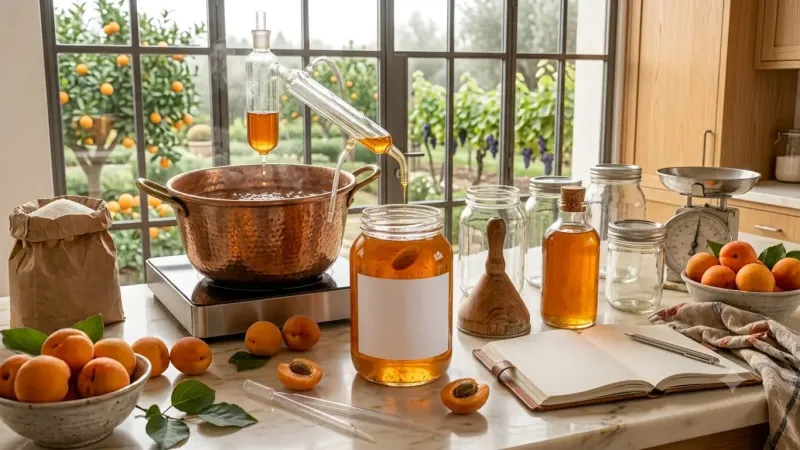
Making a traditional homemade syrup from fruit with a high carotenoid content, such as apricots, usually involves blending or juicing the fruit, mixing it with water and a larger amount of sugar, and then cooking it down (reducing it) until it thickens. From a scientific standpoint, several opposing processes take place during this procedure.
The Dilution Effect: Why Syrup Is Nutritionally "Poorer"
This is the key scientific fact to understand about syrups. Scientific studies analyzing the mineral and antioxidant content of various fruit products, including syrups, confirm that adding a large amount of sugar, or sugar solution, logically lowers the concentration of the original nutrients in the final product (Alshallash et al., 2023). If we compare 100 grams of fresh apricots with 100 grams of apricot syrup, the syrup will contain substantially less carotenoids, minerals (potassium, magnesium), and vitamins. The reason isn't only that these compounds are destroyed by cooking, but mainly that a large portion of the syrup's volume consists of added sugar and, in some cases, water.
According to available analyses, fruit syrups typically retain only a fraction — often around half — of the minerals present in the raw fruit, mainly as a result of dilution by sugar. (based on Alshallash et al., 2023)
A look at the numbers: how much of the original nutrients remains in syrup?
| Fresh apricots | 100% |
| Apricot syrup | ~50% |
The values represent an approximate share of minerals and carotenoids retained compared with fresh fruit, not an exact laboratory measurement of one specific product.
← Swipe sideways →
Home Processing Tips: Syrup With Maximum Health Value
If you don't want to give up homemade syrups but want to get as much of the "orange miracle" out of them as possible, science offers a few solutions.
The Golden Rule of Consumption: Fat Is Still Essential
Even with syrups, the unforgiving law of biochemistry applies: carotenoids are fat-soluble. If you mix apricot syrup with water and drink it on an empty stomach, your body will quickly get energy from the sugar, but most of the carotenoids will simply pass through unused. To be absorbed, they need the presence of fat. The solution is to add syrup to full-fat plain yogurt, drizzle it over a curd cheese dessert, or drink it after a meal that contained fat.
Conclusion
Homemade syrups made from fruit with a high carotenoid content are always something of a nutritional compromise. On one hand, the heat used in their preparation helps release valuable antioxidants; on the other, the large amount of added sugar dilutes them and lowers their overall nutrient density. However, if you don't make the syrup from clear juice alone, but leave the pulp in, protect it with vitamin C, store it in the dark, and consume it in the presence of fat, you turn it from ordinary sweet water into a functional and delicious addition to your diet. Science shows us that even with such a traditional product as syrup, small changes in the process can significantly affect how much health we ultimately preserve in it.
|
Grow Your Own Orange Miracle Discover apricot and peach varieties rich in carotenoids in our shop, and grow fruit at home that you can turn into the healthiest homemade syrups. Browse varieties → |
Follow Us on Facebook Share your growing experience, ask about varieties, and see others' harvests on our Facebook page full of enthusiastic fruit growers — join the discussion with experts and get access to new articles first. Follow us → |