









European Plum – Traditional vs. Modern Varieties | Size, Shape & Stone
Clash of Generations in the Orchard
The physical evolution from traditional to modern varieties of the European plum (Prunus domestica)
From grandma's garden to the supermarket shelf
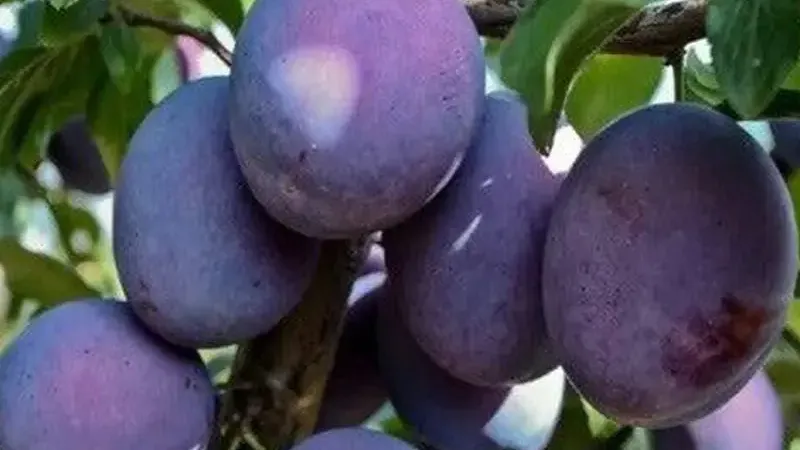
Close your eyes and recall the plum of your childhood. You probably picture a smaller, elongated, dark-blue fruit whose golden-yellow flesh separated perfectly from the stone when broken open. It was the ideal plum for thick jam or for drying. Yet if you walk through the fruit section of a modern supermarket today, you are greeted by plums that resemble small apples – large, almost perfectly round, with colours ranging from purple to mahogany.
This visual and tactile difference is no accident. It is the result of decades of intensive breeding of Prunus domestica L. (the European plum). Whereas the past emphasised the technological properties of fruit destined for processing, today's fresh-market trade uncompromisingly demands size, attractive appearance and firmness. In this article we draw on precise scientific measurements to examine how the physical properties and structure of the European plum changed during the transition from traditional to modern varieties.
Basic anatomy: what makes up the physical body of a plum?
Before comparing individual varieties, let us define the physical standard of the Prunus domestica fruit. The fruit is a drupe, which physically consists of two main components: the flesh (mesocarp and exocarp) and the stone (endocarp).
According to standardised data (Drying Atlas, 2020), the flesh makes up 93 to 96 % of the total fruit weight, while the stone accounts for only 4 to 7 %. The physical dimensions of plums are generally divided into three categories.
As the data will show, however, modern breeding pushes these tabulated limits for large fruit considerably upward.
Weight and dimensions: a clash of weight classes
Fruit weight is the principal quantitative heritable trait that determines not only total yield but, above all, consumer acceptance (Milošević et al., 2013).
|
23.93 g
traditional 'd'Agen'
|
66.70 g
modern 'Čačanska Rana'
|
74.20 g
British 'Reeves'
|
The vast gap between old and new varieties stands out in the specific measurements. In a Serbian study (Milošević et al., 2013), the traditional French variety 'd'Agen' (the historical standard for prune production) was compared with modern Balkan and global hybrids. While the traditional 'd'Agen' reached an average weight of only 23.93 g, the modern 'Čačanska Rana' dominated at up to 66.70 g. Further varieties such as 'Čačanska Najbolja' (50.80 g) and 'Bluefree' (49.59 g) also confirmed the trend toward larger fruit, with the authors noting that 'Bluefree' can reach up to 70 g under optimal conditions.
This trend is confirmed by an extensive Romanian study (Ionica et al., 2013), which evaluated 12 cultivars. Traditional local varieties showed markedly smaller physical parameters. For example, the old variety 'Tuleu de Sineşti' had an average weight of only 26.80 g and a length of 42.61 mm. At the opposite end stood modern introduced varieties. The British 'Reeves' reached an average weight of 74.20 g with a length of 47.9 mm and a width of up to 52.32 mm. Similarly, the modern Romanian 'Alina' reached 71.70 g and an extreme length of 57.35 mm.
| Variety | Type | Weight (g) | Length (mm) | Width (mm) |
|---|---|---|---|---|
| 'd'Agen' | traditional | 23.93 | – | – |
| 'Tuleu de Sineşti' | traditional | 26.80 | 42.61 | – |
| 'Bluefree' | modern | 49.59 | – | – |
| 'Čačanska Najbolja' | modern | 50.80 | – | – |
| 'Čačanska Rana' | modern | 66.70 | – | – |
| 'Alina' | modern | 71.70 | 57.35 | – |
| 'Reeves' | modern | 74.20 | 47.90 | 52.32 |
← Swipe the table sideways →
For an exact comparison of fruit volume, scientists use the so-called size index, calculated as the average of fruit length, width and thickness. While the traditional 'Oltenal' had a size index of only 25.11, the modern 'Reeves' reached 50.55 – physically a fruit with double the spatial parameters (Ionica et al., 2013).
Shape, colour and visual appeal
The physical structure of the fruit is not only about size but also about the shape and colour of the skin (exocarp). Traditional plums (such as the German 'Pozegaca' or the French 'Prune d'Ente') typically have an elongated-oval shape and a blue-black, glossy skin (Drying Atlas, 2020).
Modern breeding, however, has brought enormous diversity. In her microscopic and morphological study, Konarska (2015) compared the traditional 'Sweet Common Prune' type with the modern large-fruited varieties 'Bluefre' and 'President'.
Shape: While the traditional 'Sweet Common Prune' retains an elliptical to ovoid shape, the modern 'Bluefre' is spherical-elliptical (rounder) and 'President' is robustly oval.
Colour and wax: The skin colour is formed by anthocyanins in the epidermis, but the visual impression is determined by the epicuticular wax. The traditional 'Sweet Common Prune' has a brown-blue to dark-blue skin with a dense whitish waxy bloom. The modern 'Bluefre' boasts a dark-blue colour with an exceptionally rich, bright bloom, while 'President' shades into burgundy-purple tones with a purple-blue wax (Konarska, 2015). The Romanian study (Ionica et al., 2013) adds that modern varieties such as 'Excalibur' bring an attractive red-purple colouring to the market that differs markedly from the traditional plum blue.
Texture, firmness and the stone: physics inside the fruit
For both the consumer and the processing industry, the internal physical structure is crucial – the firmness of the flesh and its relationship to the stone (endocarp).
Stone separability
Traditional varieties intended for drying and canning are characterised by a stone that separates very easily from the flesh (freestone). Konarska (2015) confirms that in the traditional 'Sweet Common Prune' the stone separates very easily. In modern large-fruited varieties, however, this is no longer the rule. In 'President' the separation is rated only as easy, and in the modern 'Bluefre' it is even rather difficult. For the fresh-fruit market this is not a fatal flaw, but for the processing industry (mechanical pitting) it represents a physical obstacle.
A note on processing: Large-fruited modern varieties with a stone that is harder to separate are not ideal for mechanical pitting or drying. For jam and dried prunes, traditional freestone varieties remain the better choice.
Firmness and juiciness
Modern varieties must withstand transport and a longer time on the shelf. They are therefore bred for greater flesh firmness and skin resistance. In a sensory and physical panel (Roussos et al., 2016), varieties were assessed on a scale of 1 to 5. The modern 'Vinete de Italia' scored the maximum for size (5/5), yet its firmness was rated only average (3/5). Similarly, the large-fruited 'Valor' (size 5/5) had lower skin resistance and medium firmness. By contrast, the traditional Central European gage 'Renclod Althan' excelled in flavour but, physically, had the lowest juiciness.
The modern orchard is no longer merely a place of cultivation but a precisely calculated factory, where the physical properties of the fruit are selected to match its ultimate destiny.
Conclusion
The physical evolution of the European plum (Prunus domestica) is a story of how human demands shape nature. The scientific data (Ionica et al., 2013; Milošević et al., 2013; Konarska, 2015) clearly show that modern varieties physically surpass traditional ones in parameters such as weight, length, width and the visual appeal of shape and colour. They have become heavy, rounder and more colourful fruit, ideal for the eye of the modern consumer.
Although traditional varieties (such as 'd'Agen' or 'Tuleu de Sineşti') lose this clash of weight classes, their physical structure – smaller volume, high dry-matter content and perfect stone separability – makes them an irreplaceable material for technological processing, especially drying (Drying Atlas, 2020). Each variety thus has its firm place: whether it ends up in the dryer or as a perfect, large fruit in a discerning customer's basket.
|
Choose your plum variety straight for your orchard
From traditional jam plums with perfectly separating stones to large-fruited modern varieties for the fresh table – our range offers grafted young trees for every purpose. Choose by flavour, ripening time and intended use. Go to the shop → |
Join our community of fruit growers
Exchange growing experiences, ask about varieties and share your harvest on our Facebook page full of passionate fruit growers. Discuss with experts and get early access to new articles. Visit our page → |