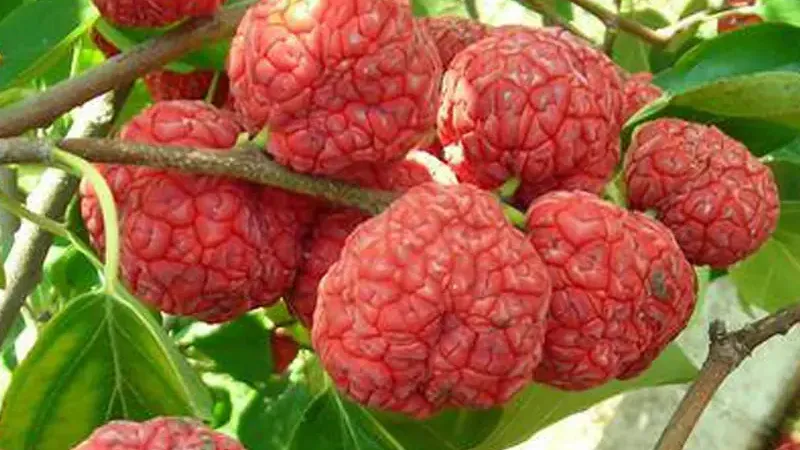
Che, or Chinese mulberry (Maclura tricuspidata), is one of the most intriguing exotic trees that can be grown successfully even in Central European conditions. Its round, bumpy fruits resemble a giant raspberry or mulberry, and their flavour evokes a blend of ripe melon and papaya. In this article we present six key items from our range – five female varieties and the indispensable male pollinator.
|
−25 °C
cold hardiness
|
2–3 cm
fruit diameter
|
0
sprays for organic
|
Che is a dioecious plant – there are separate female and male trees. Some female varieties are strongly parthenocarpic, meaning they can produce completely seedless fruit even without a pollinator. For maximum and reliable yields, however, most growers choose to plant a female alongside a male pollinator.
Shared strengths of all che trees: late flowering (not until June) reliably protects the blossoms from late spring frosts, the tree is exceptionally resistant to diseases and pests, and it is ideal for organic growing without any chemical sprays.
Female Varieties
'Darrow'
Considered worldwide one of the highest-quality female varieties. It was bred by the renowned American breeder Dr. George M. Darrow in the USA. The tree is moderately vigorous (3–4 m), easy to control with pruning, and the young shoots carry small thorns that disappear with age.
It is a strongly parthenocarpic variety – it needs no male at all to set completely seedless fruit. The fruits are round, dark red at full ripeness, with deep-red, very juicy flesh. The flavour is harmoniously sweet and exotic, reminiscent of red and honeydew melon with a hint of papaya.
It ripens late, gradually from late October into November, and comes into bearing early, usually as soon as the 3rd year after planting.
Tip: When grown without a pollinator, the plant invests no energy in forming seeds, which makes the fruit even sweeter and more concentrated in flavour. You can tell ripeness because the fruit detaches easily without releasing white milky sap.
'Chul Ri'
A newer, very promising Korean cultivar from South Korea, brought to wider attention by the legendary American grower of rare fruit, Cliff England. It is notable for its exceptionally early start to bearing – it often produces its first fruit as soon as the first year after planting – and for its very fast growth (3–5 m).
It is a female selection. It is not yet confirmed with certainty whether it is strongly parthenocarpic, as observations so far have taken place only near male trees. It requires full sun and evenly moist roots during summer heat.
Highly cold hardy (USDA zones 5b to 9), with no diseases or pests observed.
'Adam Barr'
A specific cultivar from the USA, sought after mainly in the collections of rare-fruit enthusiasts. Named after the grower Adam Barr, it entered distribution chiefly through American nurseries focused on exotic fruit. It is prized for its above-average fruit size and its ability to set seedless fruit.
Growth is moderate to vigorous and regular pruning is recommended. Harvest the fruit only when fully soft with a deep, dark-red colour. The variety has potential as an "edible landscape plant" – a tree serving both ornamental and productive roles in the garden.
It ripens very late (October/November) and in cooler regions requires a long, warm autumn.
Note: Documentation for the 'Adam Barr' and 'Darren Bender' varieties is minimal. They are rated extremely well on discussion forums, but we personally do not rely on parthenocarpy and recommend planting them together with a pollinator.
'Darren Bender'
A named cultivar from the USA that appears mainly in the collections of specialist growers and enthusiasts. Although commercial documentation is limited, it is well known in the rare-fruit community. It carries the name of the grower Darren Bender.
Growth is moderate to vigorous, and the fruits rank among the larger ones within the species. It is a female, parthenocarpic variety – but for maximum yield, pollination by a male plant is recommended. It is valued above all for its collector's appeal and overall easy care.
It ripens very late and, like other che trees, withstands frosts down to −25 °C (USDA zones 5b to 9).
'Hwang Kum #2' – the pick of the range
A top-tier modern Korean cultivar from 2012 (bred by Seonjin Horticulture Seed Co.), also sold in Korea as "Super Red Berry". After testing, large-scale domestic growers rate it as the very best variety on the market, and Cliff England calls it the variety with the finest fruit of all.
It grows as a compact, dense shrub or small tree with a round crown that Korean breeders compare to a juniper. Its wood is exceptionally hard. The fruits are very large, perfectly spherical, uniform and extremely juicy, with outstanding flavour. Thanks to the compact growth and densely set fruit, harvesting is extremely easy – almost no ladder needed.
Early ripening (from late September to mid-October) ensures the fruit ripens even in cooler regions. It comes into bearing as soon as the 2nd year after planting. It is a female variety that requires a male pollinator.
The Male Pollinator – Key to the Harvest
The male che pollinator (Maclura tricuspidata) is a suitable partner for all female varieties. While it bears no fruit itself, its presence in the garden is absolutely key to an abundant, regular and stable harvest. Without a good pollinator, female plants often drop fruit prematurely or fail to set at all.
Diagnosing a yield problem:
The female flowers abundantly but the fruit drops or fails to ripen → almost always a case of insufficient pollination.
Solution: plant a male pollinator on the windward side, 4–5 m from the female.
Result: reliable conversion of flowers into juicy fruit on all female cultivars.
The pollinator flowers late (usually in June), thus avoiding spring frosts. When the pollen matures, the male flowers turn intensely yellow and release pollen into the surroundings – che trees are, after all, wind-pollinated. A single male tree can reliably pollinate several female plants. It is naturally smaller and more compact, so it fits even into the edges of a plot, and needs only one pruning per year.
Quick Variety Comparison
| Variety |
Ripening |
Seedless without male |
Start of bearing |
| 'Darrow' |
Oct–Nov |
yes (strongly parthenocarpic) |
3rd year |
| 'Chul Ri' |
late |
unconfirmed |
often 1st year |
| 'Adam Barr' |
Oct–Nov |
reportedly yes |
– |
| 'Darren Bender' |
Oct–Nov |
reportedly yes |
– |
| 'Hwang Kum #2' |
early (Sep–Oct) |
no (requires male) |
2nd year |
The later the fruit is picked, the sweeter it gets. And one simple rule applies – if you want a sure and abundant harvest, always add a male pollinator to your females.
Che is a superb choice for anyone seeking an easy-care, cold-hardy yet exotic fruit. Whether you prefer the early, compact 'Hwang Kum #2' or the proven, self-fruiting 'Darrow', che brings you a unique flavour that remains a rarity in Central European gardens.
|
Choose your che tree
From the sweet, seedless 'Darrow' to the giant 'Hwang Kum #2' – discover the exotic melon-and-papaya flavour straight from your own garden. Our shop offers proven varieties and the essential pollinator.
Visit the shop → |
Join fellow fruit growers
Share your growing experience, ask about varieties and show off your harvest on our Facebook page full of enthusiastic fruit growers. Discuss with experts and be the first to access new articles.
Visit the page → |