


Loganberry and Boysenberry – History, Comparison and Growing Guide
Hybrid berries · Rubus hybrids
The 'Loganberry' and the 'Boysenberry'
The first raspberry–blackberry cross and its famous descendant – history, comparison and growing guide
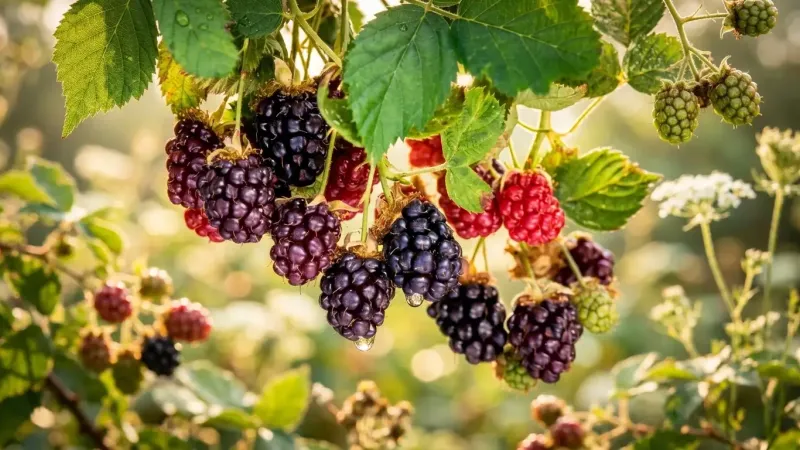
Hybrid berries are crosses between raspberries and blackberries that combine the strengths of both parents. Two of them hold a special place. The 'Loganberry' was the very first significant cross between a blackberry and a raspberry and became the genetic foundation for many later varieties. One of these is the 'Boysenberry', regarded as one of the tastiest berries of all.
Both varieties appeal less to commercial growers today – the 'Loganberry' because harvesting is demanding, the 'Boysenberry' because its berries are too soft to transport. That is exactly why they belong in home gardens, where they can show what they are truly capable of. Here you will find their story, a side-by-side comparison and practical growing advice.
| 1881'Loganberry' arises | 1932first 'Boysenberry' fruit sold | 7–8 kg'Loganberry' yield per plant | ~8 g'Boysenberry' berry weight |
← Swipe the table sideways →
Family tree and the story of two legends
The 'Loganberry' (Rubus × loganobaccus) is an interspecific hybrid (a hexaploid) between the North American trailing blackberry 'Aughinbaugh' (Rubus ursinus) and the European red raspberry 'Red Antwerp' (Rubus idaeus). The 'Boysenberry' has an even more complex background – it combines the genetics of the European raspberry (Rubus idaeus), the European blackberry (Rubus fruticosus), the American trailing dewberry (Rubus aboriginum) and the 'Loganberry' itself.
At a glance
Although the 'Loganberry' is one of the parents of the 'Boysenberry', these two hybrid berries behave quite differently in the garden:
| Trait | 'Loganberry' | 'Boysenberry' |
|---|---|---|
| Origin | chance hybrid, 1881, Santa Cruz | exact origin unclear; fruit sold from 1932 |
| Berries | elongated, like a large blackberry | large, around 8 g on average |
| Colour when ripe | dark wine-purple | dark maroon |
| Seeds | very small and soft | medium-sized |
| Flavour | sweet-tart, refreshing, with a wine-like note | sweet-tart, rich, with the aroma of wild raspberries and blackberries |
| Hardiness | highly resistant to frost and fungal diseases | prone to grey mould in wet weather |
| Position | sunny, tolerates partial shade | direct, full sun |
| Soil | ordinary, well-drained | fertile, loamy, well-drained, pH 5.6–6.5 |
| Harvest | gradual, over about 2 months | very soft berries that must be processed immediately |
| Yield | 7–8 kg from a mature plant | high when properly trained on a trellis |
| Lifespan | around 15 years | 15–20 years |
| Thornless form | 'American Thornless' (since 1933) | thornless clones (New Zealand, 1980s) |
← Swipe the table sideways →
The 'Loganberry' up close
The plant
In its growth habit, the plant takes after the blackberry. Instead of upright canes, it produces very long, trailing, flexible canes that can grow 1.5 to 2 metres in a single year. The total annual growth of all the canes on one plant can reach 12 to 15 metres.
Annual cane growth of the 'Loganberry'
| One cane per year | 1.5–2 m |
| All canes on one plant per year | 12–15 m |
Bar length reflects the upper end of each stated range on a 0–15 m scale.
← Swipe sideways →
It is a very long-lived, vigorous plant that can crop heavily in the same spot for up to 15 years.
Fruit and flavour
In shape and size the berries resemble a large, elongated blackberry, but they are not black. While ripening they are bright red, and when fully ripe they turn a deep, dark wine-purple. A major advantage over common blackberries is the very small, soft seeds, which barely get in the way when eating.
The flavour combines the aromas of both parents: pleasantly sweet and tangy, refreshing, with a subtle wine-like undertone.
Harvest
A distinctive feature of this variety is very gradual ripening over about two months, from midsummer into autumn. On a single cane you will find flowers alongside green, red and fully ripe purple berries. The fruit is also often hidden beneath large leaves, which is why the 'Loganberry' is rarely grown commercially.
When to pick 'Loganberry' fruit
iExcellent yields
A mature plant can produce 7 to 8 kg of fruit per season. When harvesting, remember to look under the leaves – that is often where the ripest berries hide.
The 'Boysenberry' up close
The plant
The plant has a typically trailing (prostrate) habit. Rather than upright canes like a raspberry, it produces long, flexible canes that creep along the ground. It is a long-lived perennial – with proper care, it will last 15 to 20 years in the same spot.
Fruit and flavour
The fruit is a large aggregate of drupelets weighing around 8 grams on average. As it ripens, it turns a deep, dark maroon. The seeds are medium-sized. The skin is extremely thin and the berries are exceptionally soft – when fully ripe, the slightest pressure releases dark juice that stains readily.
Flavour is the main reason to grow this variety. It is perfectly balanced, sweet and tangy, with a rich, complex profile that combines the aroma of wild raspberries and wild blackberries.
"This is my favourite hybrid berry by far. Neither raspberry nor blackberry dominates – it is practically a completely new fruit."— from our own growing experience
Harvest and shelf life
The variety's greatest weakness is closely tied to its greatest strength. The thin skin and juicy flesh that give it such an outstanding flavour also mean the berries cannot be stored. After picking, they begin to deteriorate and ferment within a few days – often within hours.
!Eat or process the berries right away
Ripe 'Boysenberry' fruit should be eaten or processed almost immediately after picking. In very wet weather, the berries are also more prone to fungal diseases, especially grey mould (Botrytis).
iBoth are excellent for preserving
Both hybrid berries make superb jams, syrups and pies. The 'Boysenberry' gives ice creams and jams a striking dark colour and rich aroma, while the 'Loganberry' is also well suited to fruit wines.
Growing both varieties
Position and soil
The 'Loganberry' is less demanding – it tolerates partial shade, although it produces the sweetest fruit in a sunny position with ordinary, well-drained garden soil. The 'Boysenberry' needs direct, full sun and fertile, loamy and above all well-drained soil that is slightly acidic (pH 5.6–6.5). It responds well to nitrogen feeding early in the season and benefits from a mulch of bark or straw, which suppresses weeds and keeps the soil moist.
Support and tying in
Both varieties have trailing canes and cannot be grown without firm support – the canes would lie on the ground and the fruit would rot. They are most often grown on a wire trellis, to which the canes are gradually tied in. The 'Loganberry' can also be fan-trained against a fence or wall. 'Boysenberry' plants are set 60–75 cm apart, with 2.4 to 3 metres left between rows.
Pruning – a two-year cycle
Like most blackberries, both hybrid berries fruit on one-year-old wood – canes that grew the previous year. The full life cycle of each cane therefore spans two years:
!Watch out for thorny shoots
The original forms of both varieties are thorny, so it is worth choosing thornless plants. Thornless 'Boysenberry' forms, however, often arise as bud mutations and may send up thorny shoots, which should be removed regularly.
Pollination
'Boysenberry' flowers are self-fertile, so it does not need a separate pollinator variety. Bees and bumblebees are nevertheless important for thorough pollination and well-formed berries.
Which one to choose?
If you want a reliable crop without much fuss over plant protection and do not mind picking little and often, go for the 'Loganberry'. If flavour comes first and you can eat or process the berries straight after picking, try the 'Boysenberry'. Since both need the same support and pruning, you can easily grow them side by side and compare their flavour in your own garden.
|
Choose your hybrid berry Looking for a hardy variety with heavy crops, or a hybrid berry with exceptional flavour? Our shop offers hybrid berry plants and other soft fruit for your garden. Browse varieties → |
Join our community Share growing experiences, ask about varieties and show off your harvest alongside passionate fruit growers. Talk with experts and be the first to read our new articles. Visit our Facebook page → |
Related Products