









Food of the Gods or a Bitter Letdown? Persimmon Groups PCNA, PVNA, PCA and PVA
Food of the Gods or a Bitter Letdown?
Crack the genetic code of the persimmon and uncover the secrets of the PCNA, PVNA, PCA and PVA groups
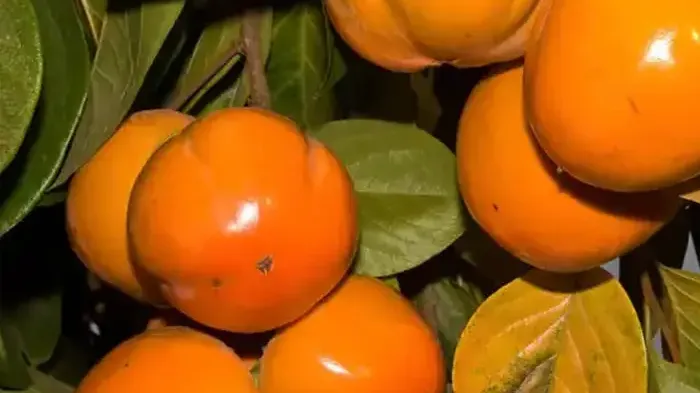
Imagine holding a beautiful, glowing orange fruit of the Japanese persimmon (Diospyros kaki). Ancient texts and pomological literature proudly call it the “food of the gods”. You bite into it expecting a luscious, honey-sweet flavour – but instead of a heavenly experience, your whole mouth puckers within a second and you feel a harsh, mouth-drying astringency at the back of your tongue. Yet another persimmon, still rock-hard to the touch, can be eaten straight from the tree like a crisp apple, its flesh perfectly sweet with a subtle hint of cloves or nuts.
How can a single fruit species offer such radically different taste worlds? The answer lies not only in ripeness, but in centuries of breeding, in the biochemistry of tannins and in a unique horticultural classification. The genus Diospyros in the ebony family (Ebenaceae) includes hundreds of species, and Japan, Korea and China alone have produced more than a thousand cultivars of the Japanese persimmon. To help growers, breeders and consumers find their way through this enormous diversity, pomology has divided all persimmon varieties into four basic groups: PCNA, PVNA, PCA and PVA. Let us lift the veil on the science behind these abbreviations.
|
1,000+
cultivars in Japan, Korea and China
|
4
pomological variety groups
|
0.5%
soluble tannins – the limit of edibility
|
2n = 90
chromosomes in common persimmon (hexaploid)
|
← Swipe the table sideways →
The Anatomy of Astringency: What Happens Inside the Fruit?
Before looking at the individual variety groups, we need to understand the main culprit behind the puckering taste – tannin. Every young, developing persimmon fruit is highly astringent in its early stages of growth. This is caused by soluble tannins (high-molecular-weight plant polyphenols) that accumulate in the vacuoles of large specialised cells known as tannin cells.
When you bite into an astringent fruit, your teeth rupture the walls of these cells and saliva immediately releases the soluble tannins. They bind very strongly to proteins in the mouth and readily stick to the tongue, causing an instant puckering sensation and a bitter, astringent taste. Fruit containing more than 0.5% soluble tannins is practically inedible.
A chemical portrait of persimmon tannin
In 1923, scientists assumed a simple empirical formula of C14H20O9, and in 1962 leucodelphinidin-3-glucoside was named as the main component. Later research showed that it is in fact a complex conjugated tannin. Its backbone is leucodelphinidin, to which gallic acid, gallocatechin and gallocatechin-3-O-gallate are bound (together with catechin and catechin-3-O-gallate).
For a persimmon to become edible, its tannins do not turn into sugar. They must polymerise (coagulate or precipitate) – that is, change from a soluble to an insoluble form – or their concentration must drop below the threshold of perception. The way the tree and fruit deal with these tannins is exactly what determines which of the four groups a variety belongs to.
Horticultural Classification: The Four Pillars of the Persimmon World
The first criterion divides varieties according to whether they are astringent at harvest maturity. Non-astringent varieties (NA) lose their astringency naturally on the tree as the fruit develops, while astringent varieties (A) retain it until harvest.
The second criterion is how the flesh responds to pollination and the presence of seeds. If the flesh colour of the ripe fruit stays the same (yellow-orange to orange) regardless of whether the fruit contains seeds or developed parthenocarpically (without seeds), the variety is pollination-constant (PC). If, however, seeds formed after pollination cause the flesh to darken (turn brown) through oxidation and polymerisation of tannins, while seedless fruit of the same variety remain light, the variety is pollination-variant (PV).
Combining both criteria gives four pomological groups that differ in both astringency behaviour and flesh colour:
| Group | Nickname | Astringent at harvest | Effect of seeds on flesh | Brown specks | When the fruit is edible |
|---|---|---|---|---|---|
| PCNA | “complete sweet persimmon” | never | none | always, a few tiny specks | right away, even when firm – with or without seeds |
| PVNA | “incomplete sweet persimmon” | only if seeds are lacking | flesh darkens | around seeds; with good pollination throughout | firm, if it has enough seeds |
| PCA | “complete astringent persimmon” | always | none | never | once fully soft or after astringency removal |
| PVA | “incomplete astringent persimmon” | always | local browning around seeds | only in a small ring around seeds | once over-ripe or after post-harvest treatment |
← Swipe the table sideways →
The Biochemistry: Why Do Seeds Change the Colour and Taste of the Flesh?
Why do seeds in the PVNA and PVA groups cause the flesh to brown and lose astringency, while nothing of the kind happens in PCNA and PCA? The answer came from ground-breaking research by Japanese scientists (Sugiura et al., 1979, 1983, 1984, 1985), which revealed two completely different mechanisms.
1. The Volatile-Dependent Group (VDG)
This category includes all non-PCNA varieties, i.e. the PVNA, PVA and PCA groups. Their fruit accumulate large amounts of tannin in tannin cells up to the middle stage of fruit development. The key to losing astringency on the tree is the ability of the developing seeds to produce volatile compounds – ethanol and, above all, acetaldehyde.
A shared advantage of the VDG
The tannins of the PVNA, PVA and PCA groups readily coagulate on contact with volatile compounds even at the immature stage. After harvest, their astringency can therefore be removed easily with ethanol vapour or CO2 gas.
2. The Volatile-Independent Group (VIG)
This group consists exclusively of PCNA varieties. Here, astringency is lost in a completely different way that has nothing to do with acetaldehyde production in the seeds. Although the seeds of some 'Fuyu'-type cultivars can produce these compounds, PCNA fruit lose their astringency even when they are entirely seedless.
The secret of PCNA is that the tannin cells stop accumulating tannin at a very early stage of fruit growth – in 'Jiro', roughly during July. As the fruit keeps growing vigorously through August, September and October, the small existing amount of tannin is literally “diluted” in the expanding flesh until it falls below the threshold of perception.
An intriguing paradox: if you picked an immature, still astringent PCNA fruit and exposed it to ethanol vapour, its tannins – unlike those of the VDG – would neither react nor coagulate.
!A climate warning for growers in cooler regions
The expression of the PCNA trait is strongly influenced by the environment, especially temperature. Natural loss of astringency in PCNA varieties such as 'Fuyu' or 'Jiro' only takes place reliably in warm regions. In areas with a shorter, cooler growing season, the fruit remain astringent at harvest – and, worse still, their tannins do not polymerise even after harvest when exposed to ethanol vapour.
A Detailed Profile of Each Group and Its Main Varieties
1. The PCNA Group: Kings of the Fresh Market
From both a commercial and a consumer point of view, PCNA varieties are the most sought-after in the world. They can be eaten firm and crisp straight from the tree without any post-harvest treatment. According to the UPOV guidelines, they reach eating maturity when the flesh is still firm and the skin has changed colour. Their flesh always contains small to medium-sized brown specks.
!Watch the rootstock
Some seedling strains of Diospyros lotus show graft incompatibility with 'Fuyu'. When buying a grafted tree, it is worth checking which rootstock it has been grown on.
A biochemical curiosity
In terms of sugar accumulation, 'Fuyu', 'Jiro', 'Atago' and 'Hanagosho' belong to the so-called sucrose type: sucrose builds up continuously during ripening (and reducing sugars as well after August). In ripe 'Fuyu' fruit, malic acid also rises sharply among the organic acids.
2. The PVNA Group: Chocolate Surprises That Depend on Pollinators
With adequate pollination and seed formation, PVNA fruit are excellent – sweet and crisp, with attractive brown flesh. If pollination fails and the fruit stays seedless, however, it disappoints not only with its pale colour but also by remaining astringent. That is why modern commercial breeding regards them as less predictable.
3. The PCA Group: Masters of Sweetness, Drying and “Sharon Fruit”
PCA varieties keep a high content of soluble tannins until full maturity, and their flesh never contains brown specks. Without treatment, they only become edible once they soften completely to the consistency of thick jelly when stored at room temperature (around 15 °C). The reward for patience is that over-ripe astringent varieties are often noticeably sweeter and more aromatic than non-astringent cultivars such as 'Fuyu'. Varieties with melting flesh are also irreplaceable for the traditional drying of whole peeled fruit – during drying the tannins polymerise, the astringency disappears and a fine white bloom of crystallised sugar forms on the surface.
4. The PVA Group: Seedless Giants and Champions of Parthenocarpy
PVA varieties are astringent at harvest. If seeds do form, brown coagulated tannins appear only in a small ring around each seed. Yet this group includes some of the most economically important cultivars in the world, which have an exceptionally strong capacity for parthenocarpy (setting fruit without pollination).
Quick guide: When is the fruit ready to eat?
| PCNA – eat as soon as the skin has coloured, even firm and crisp. | |
| PVNA – eat firm only if the fruit has several seeds and brown flesh; pale, seedless flesh is usually astringent. | |
| PCA and PVA – let the fruit soften completely, remove the astringency (ethanol, CO2) or dry it. |
Genetics, Ploidy and the Future of Persimmon Breeding
A look into the cell nucleus reveals why breeding new varieties is such a challenge. The basic chromosome number of the genus Diospyros is x = 15. Wild and rootstock species such as the date-plum (D. lotus) and D. oleifera are diploids (2n = 30). The American persimmon (D. virginiana) forms tetraploid (2n = 60) and hexaploid (2n = 90) races whose ranges overlap in Kentucky. The cultivated Japanese persimmon (D. kaki) is a hexaploid (2n = 6x = 90), or the nonaploid (2n = 9x = 135) mentioned above.
Chromosome number (2n) in the genus Diospyros
| D. lotus, D. oleifera (diploids) | 2n = 30 |
| D. virginiana (tetraploid race) | 2n = 60 |
| D. kaki and the hexaploid race of D. virginiana | 2n = 90 |
| 'Hiratanenashi', 'Tonewase' (nonaploids) | 2n = 135 |
| 'Jiro' after colchicine treatment (dodecaploid, experimental) | 2n = 180 |
Bar length is relative to a range of 0–180 chromosomes (the highest number achieved). The basic chromosome number of the genus is x = 15.
← Swipe sideways →
Interspecific hybrids of D. virginiana × D. kaki (such as 'Rossiyanka' and 'Nikitskaya Bordovaya') are also gaining ground in practice. They combine a high proportion of flesh (up to 95%), few seeds (1.7 on average) and adaptability to temperate-zone conditions.
The main goal of breeding programmes in Japan, Korea, China, Israel and Brazil is to obtain early, large-fruited PCNA varieties with high eating quality, long storage life and resistance to apex and calyx cracking. The catch lies in inheritance:
Why breeding PCNA is so difficult
• The PCNA trait is inherited qualitatively, but it is recessive to the non-PCNA trait (i.e. to the PVNA, PVA and PCA groups).
• Fruit astringency itself is controlled by two to three pairs of alleles. A new seedling will only be PCNA if it is homozygous recessive for all of them.
Since waiting several years for a seedling to grow and bear fruit is inefficient for breeders, modern science has turned to advanced biotechnology:
Conclusion
The mystery of persimmon astringency no longer has to be a lottery at harvest or at the market. Once we understand the difference between the “silent dilution of tannins” in the PCNA group and the “acetaldehyde alchemy of the seeds” in the PVNA, PVA and PCA groups, we start to see every fruit through completely different eyes.
Whether you choose crisp, carefree 'Fuyu', 'Jiro' and 'Izu' for your garden or orchard, are tempted by the chocolate flesh of well-pollinated 'Nishimurawase', or prefer the unbeatable jam-like sweetness of softened or dried 'Saijo', 'Hachiya' and the seedless nonaploid 'Hiratanenashi' – each of the four groups has its irreplaceable place in pomology and gastronomy. After all, the persimmon is not just one fruit; it is a whole palette of flavours and textures, and you now hold the right genetic key to it.
|
Grow Your Own Persimmons Browse the persimmon trees in our shop and choose a variety to suit your taste – crisp fruit straight from the tree or honey-sweet persimmons for drying and winter desserts. Browse varieties → |
Join Our Community Swap growing tips, ask about varieties and share your harvest with our community of passionate fruit growers – talk to experts and be the first to read our new articles. Follow us on Facebook → |